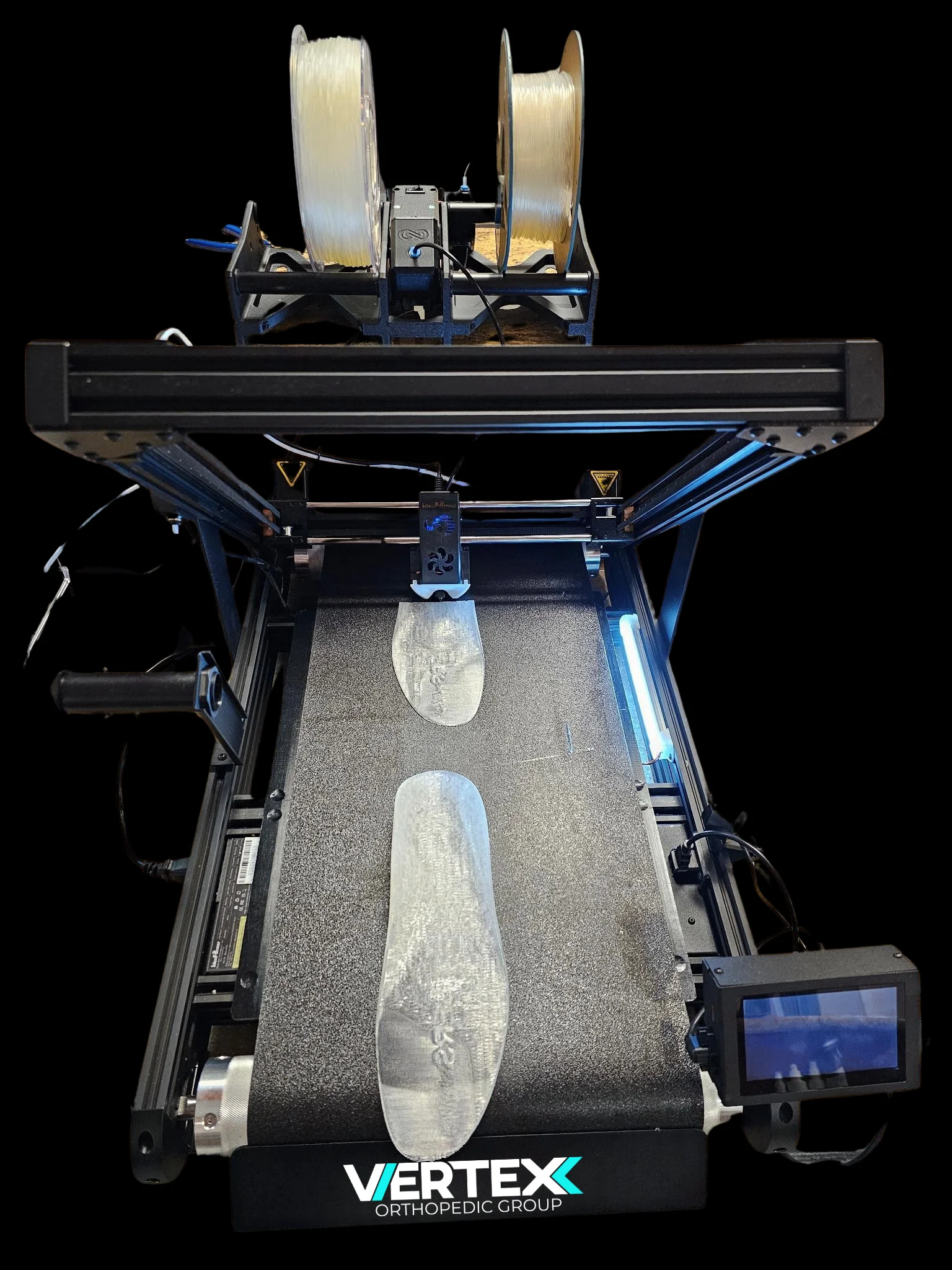
The Apex Belt V2 and XE series are Vertex-optimized high-volume belt 3D printers designed for professional production. These systems support a wide range of manufacturing applications, including orthotic and custom device fabrication in clinical and lab settings.
Design workflow: Scan → OrthoCAD → export → belt print. See also Apex V2 orthotic 3D printer and 3D printing vs CNC.
| Factor | Apex Belt V2 | Generic bed FDM |
|---|---|---|
| Part clearing | Belt ejection between jobs | Manual removal each cycle |
| Overnight production | Designed for unattended queues | Limited without staff intervention |
| Orthotic TPU tuning | Clinic-focused profiles | Variable; operator-dependent |
| CAD integration | OrthoCAD direct export | General slicer workflow |
| Typical clinic volume fit | 20–100 pairs/month | Often <20 pairs/month |
Materials cost: $10–$12 per pair. Your current outsource cost per pair: _____ (plug in your number). Monthly savings = (outsource cost per pair × pairs) − (materials + OrthoCAD subscription + printer amortization).
Example below uses $11/pair materials and $35/pair outsourced cost.
| Volume | Materials (example $11/pair) | OrthoCAD (ongoing, $1,500/yr) | Printer amortized (12 mo) | Example monthly savings ($35/pair outsourced)* |
|---|---|---|---|---|
| 20 pairs/mo | $220 | $125 | $125 | $230 |
| 50 pairs/mo | $550 | $125 | $125 | $950 |
| 100 pairs/mo | $1,100 | $125 | $125 | $2,150 |
*Example only — plug in your own outsource cost above. Assumes $35/pair outsourced comparison and $11/pair materials.
Printer and OrthoCAD costs are fixed regardless of volume — the more pairs you produce, the lower your effective cost per pair.